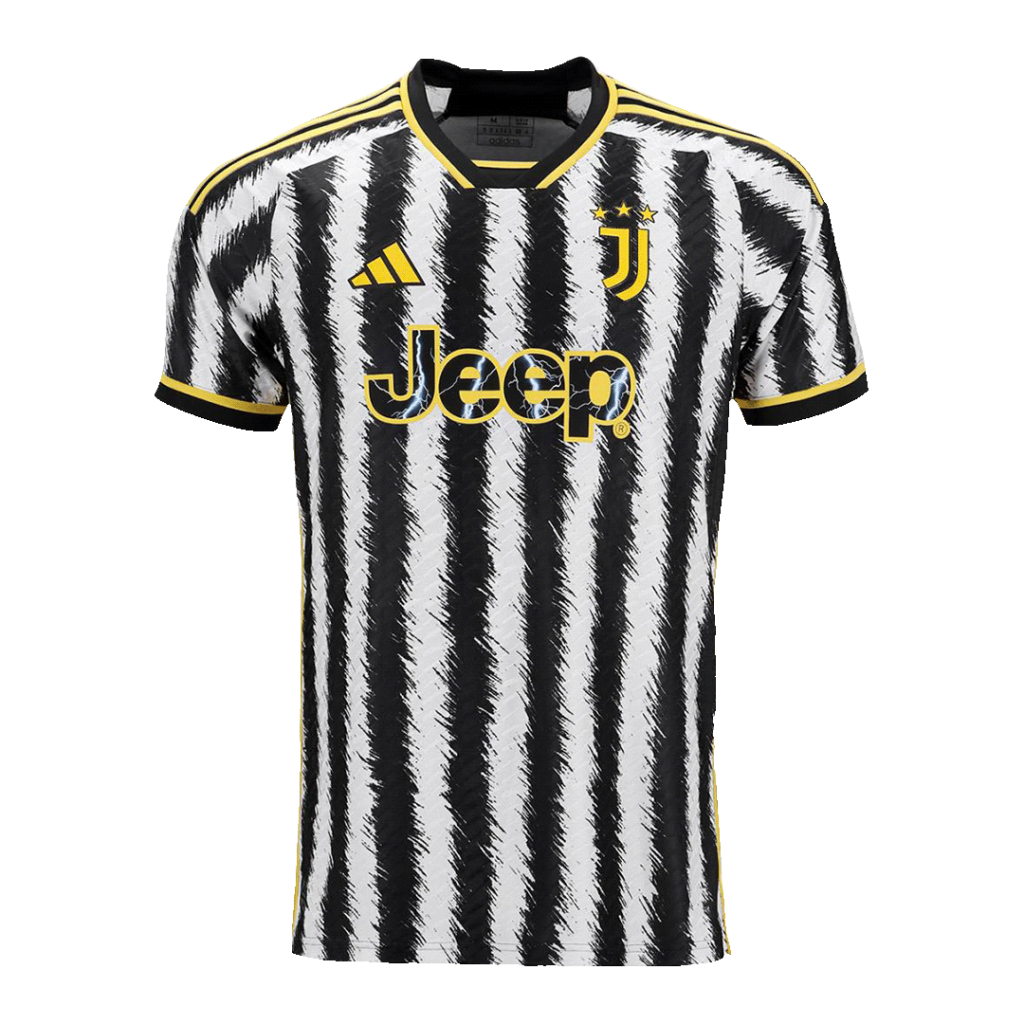
Black and white can look like a simple starting point. On a football shirt, it creates a surprisingly large field of possibilities. The width of a stripe, the shape of a collar and the placement of a badge can all alter a design while leaving its identity easy to recognise.
A connection across countries
Juventus traces its black-and-white striped identity to 1903 and to Tom Gordon Savage, who brought the colours of Notts County to Turin. The club’s own history of that connection is a reminder that kit traditions are sometimes the result of people and relationships rather than a formal branding plan.
That origin is useful context for looking at later designs. A shirt can refer to an established idea without repeating every detail of an earlier version. The palette supplies continuity; the arrangement supplies variation.
Look at the centre line
When comparing two black-and-white shirts, start in the middle. Is the central stripe black or white? Does the neckline meet a contrasting band? Is the chest divided evenly? These questions are more informative than simply counting how many stripes appear.
Next, look at the shoulders. A plain sleeve and a striped body create a different silhouette from an uninterrupted pattern. A small accent colour can also stand out strongly against such a restricted palette.
The crest as a design element
In explaining its identity introduced in 2017, Juventus connected the new mark with the shirt’s stripes, the Scudetto and the letter J. That makes the crest a useful companion to the pattern rather than an isolated badge.
In a photograph, notice how much space the crest occupies and which colour lies behind it. The surrounding area changes its contrast and visual weight. This is an exercise in looking closely, not an attempt to authenticate a shirt from a single picture.
Compare, then return
Choose two references from different season labels in the archive. Make a short list of three visible differences, then look at them again at a smaller scale. What changed? What still makes the design feel familiar? Those two questions are at the heart of following kit culture.